Vinyl or Nitrile? A Distributor's Guide to Supplying Food Factories in Iraq and Egypt
For a distributor supplying food factories in Iraq and Egypt, the practical answer is: stock vinyl gloves as the high-volume line for short, frequent-change food handling, and nitrile gloves for wet, greasy and longer tasks where vinyl tears or slips — then fix the specification, the documents and the carton plan in writing before the first container. This guide walks through how food plants in the two markets actually use gloves, how to choose between vinyl gloves and nitrile gloves line by line, and what to confirm with your factory before you order.
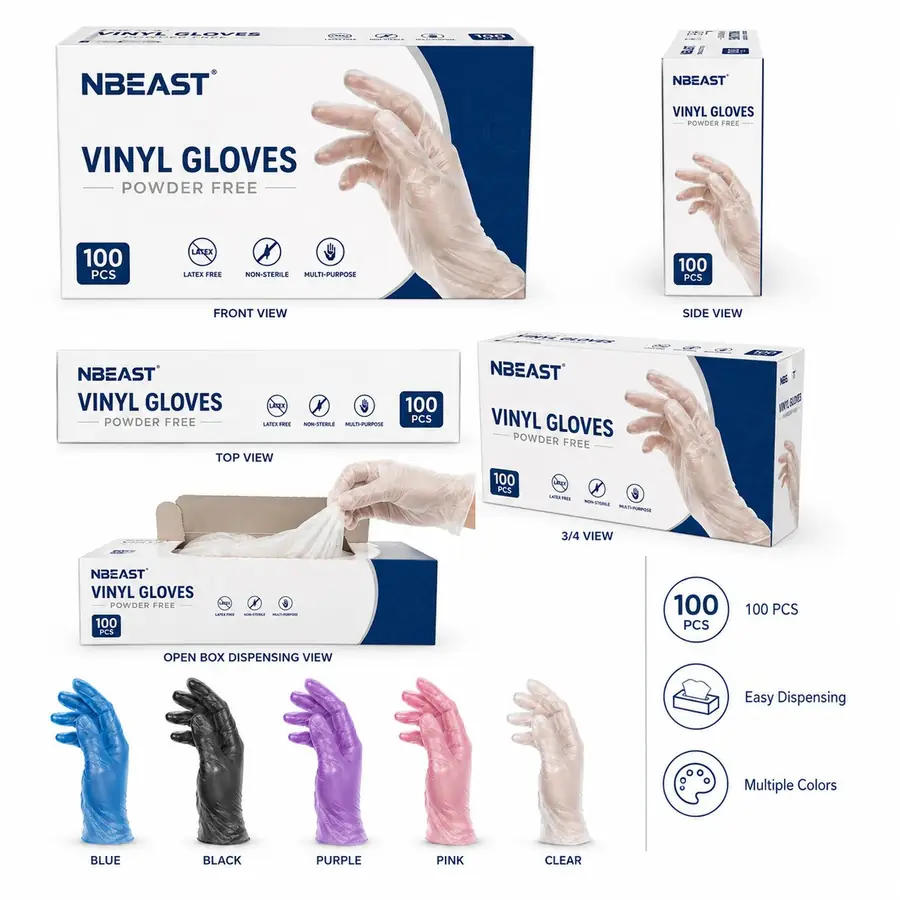
Vinyl for dry, short tasks and frequent changes. Nitrile for wet processing, oils and longer wear. Latex only where buyers accept latex protein risk. MOQ 1,000 cartons, FOB Ningbo, lead time about 30 days.
What food factories in Iraq and Egypt ask their glove distributor for
Food production in Iraq and Egypt runs on high-throughput lines: poultry and meat processing, bakeries and date packing, dairy and cheese plants, frozen vegetables, edible oil filling and large institutional kitchens. The glove is a consumable, changed many times per shift, and purchasing is usually handled by a local distributor who holds stock and delivers weekly against framework orders. That buying pattern shapes what the distributor needs from a factory supplier.
First, change frequency decides volume. A line worker who changes gloves at every break, every product switch and every contamination event can use several pairs per hour. Across a mid-size plant, that is cartons per week, not boxes — which is why the distributor's first question is rarely about a single box and almost always about carton consistency: the same weight, the same fit and the same packing in every carton, month after month.
Second, the two markets are import markets. Gloves arrive by sea, clear customs with commercial documents, and sit in the distributor's warehouse before they reach the plant. A specification that drifts between shipments creates returns the distributor cannot send back cheaply. The checks in this guide — weight per glove, palm width, carton count and documents matched to the exact product — are the ones that prevent those returns.
Third, buyers in both markets compare offers per carton and per container, not per box. A distributor who can explain, in writing, what is inside the carton (100 gloves per box, 10 boxes per carton, 1,000 gloves per carton) and how many cartons a container carries is easier to buy from than one who quotes a box figure and leaves the conversion to the customer.
Vinyl vs nitrile inside a food plant, task by task
Neither material wins everywhere. The honest split most food plants end up with is a two-line program: vinyl for the high-change dry work, nitrile for the wet and heavy work. The table below is the version we give distributors to use with their own customers.
| Task in the plant | Usual choice | Why |
|---|---|---|
| Dry packing, bakery lines, date and dry-fruit packing | Vinyl | Short wear, frequent changes, loose comfortable fit; the lowest-friction glove for tasks with no oils and no sharp edges. |
| Salad, sandwich and ready-meal assembly | Vinyl or nitrile | Vinyl where changes are constant; nitrile where workers handle wet ingredients for longer stretches without changing. |
| Poultry and meat processing | Nitrile | Wet, greasy work with knives and bone edges nearby; nitrile resists animal fats and tears less in use. |
| Edible oil filling and oily lines | Nitrile | Vinyl weakens and slips on oily contact; nitrile keeps grip and barrier on oil lines. |
| Cleaning and wash-down crews | Nitrile | Longer wear with water and detergents; a heavier nitrile weight holds up through a cleaning shift. |
| General handling, warehouse and loading | Vinyl | Light protection for short tasks; cost of change is low and comfort is high. |
Weight is the specification that ties the choice together. Our reference weights per glove are: vinyl S 3.5 g, M 4.0 g, L 4.5 g, XL 5.0 g; nitrile S 2.5 g, M 3.0 g, L 3.5 g, XL 4.0 g; latex S 4.5 g, M 5.0 g, L 5.5 g, XL 6.0 g. A distributor comparing two offers should always ask which size the quoted weight refers to — weights are quoted for one reference size, and a figure without a size is not a specification. Our glove weight check guide shows how to verify a delivery with a 0.01 g scale in about ten minutes.
Latex comes up in both markets because some buyers know it from examination use. For food lines we usually steer distributors away from latex as the main line: the fit and feel are excellent, but latex protein allergy is a real concern for plants and their auditors, and a nitrile line covers the same tasks without that conversation. Where a customer specifically asks for latex, we supply it as its own line with its own specification — see our latex gloves page.
Documents and food-contact paperwork to settle before the first order
Food factories and their auditors ask for paperwork, and the distributor is the one who has to produce it. Settle the document list before production, not when the container is on the water. For our gloves the public certification line is CE, ISO 13485 and Saudi MDMA; certificates and test reports are matched to the exact product and supplied one-to-one after an order is placed, rather than published as generic downloads, so the document a buyer files is the document for the glove they actually received.
Three checks prevent most document problems. First, the product name on the report must match the product name on the carton — a report for a different material does not cover your shipment. Second, food-contact questions should be asked as food-contact questions: which test, which simulant, which conditions. Our guide on whether nitrile gloves are food safe explains what food-contact test reports do and do not prove, in the terms buyers actually use. Third, agree in the quotation which documents travel with the shipment (invoice, packing list, certificate copies) and which are supplied one-to-one, so customs clearance and the plant's vendor file are both covered.
A note on wording: we do not present any certification we do not hold, and distributors should be careful with suppliers who do. If a buyer's auditor asks for a document, the safe answer is the document itself, matched to the SKU — not a logo on a brochure.
Building a two-line glove program for food plants?
Send us the two or three lines your customers use most — material, weight and size mix — and we will quote them as one program with a single carton plan.
Cartons, containers and lead time: the numbers a distributor plans with
Our standard packing is 100 gloves per box and 10 boxes per carton — 1,000 gloves per carton. A 70-piece box format also exists for vinyl lines where a buyer asks for it; whichever format you choose, fix it in the quotation, because carton counts per container are calculated from it. For standard 1,000-glove cartons, a 40HQ floor-loads about 4,500 cartons, and selected packing plans reach 5,000; palletised loading carries fewer. Carton gross weight is about 6 kg at the standard count for nitrile, and about 4.5 to 6 kg per carton for vinyl depending on the box format. Our container loading guide works through 20GP, 40GP and 40HQ planning in cartons and CBM.
The minimum order is 1,000 cartons, and it applies to the order as a whole: sizes S to XL, colours and the vinyl and nitrile lines of one program can be combined inside a single order, with the mix agreed in writing and every carton marked with its size and colour. Production typically takes about 30 days after order confirmation, and orders ship FOB Ningbo. Samples are available before a first order; samples and courier are not free, and the sample and courier fees are deductible from the first bulk order, so the evaluation cost lands on the order, not on the distributor's margin.
One planning habit separates distributors who grow the food-plant business from those who lose it: reorder on stock, not on complaints. With about 30 days of production plus sea transit, the reorder point is the day the warehouse still holds roughly one shipping cycle of stock. A simple per-line stock card — weekly usage per plant, cartons on hand, cartons on the water — is enough, and it is the conversation that makes a distributor the plant's glove supplier rather than one of its glove vendors.
Food factory gloves for Iraq and Egypt — FAQ
Should a food factory distributor stock vinyl or nitrile gloves?
Both, split by task. Vinyl covers dry, short, frequent-change work such as packing and bakery lines; nitrile covers wet, greasy and longer tasks such as poultry, meat and oil lines. Most distributors run vinyl as the volume line and nitrile as the heavy line, under one carton and document plan.
What glove weights should I specify for food handling?
Use the reference weight per glove and name the size it refers to. Our reference weights are vinyl M 4.0 g (S 3.5 g, L 4.5 g, XL 5.0 g) and nitrile M 3.0 g (S 2.5 g, L 3.5 g, XL 4.0 g). Heavier weights suit longer wear; standard weights suit frequent changes. Verify a delivery by weighing ten gloves per size on a 0.01 g scale and comparing the average with the agreed figure.
What documents can I show a food factory's auditor?
Our public certification line is CE, ISO 13485 and Saudi MDMA. Certificates and food-contact test reports are matched to the exact product you ordered and supplied one-to-one after the order is placed. Check that the product name on the report matches the product name on the carton before you file it with the plant.
What is the minimum order, and can I mix the two materials?
The minimum order is 1,000 cartons for the order as a whole. Vinyl and nitrile lines, sizes S to XL and colours can be combined inside one order, with the mix agreed in writing on the quotation and every carton marked with its size and colour.
How long does an order take, and how is it shipped?
Production typically takes about 30 days after order confirmation, and orders ship FOB Ningbo. A standard 40HQ floor-loads about 4,500 cartons of 1,000 gloves; plan your reorder point at roughly one production-plus-transit cycle of warehouse stock.
Are samples free for a new distributor?
No. Samples and courier are charged, and both fees are deductible from your first bulk order. That way the sample you approve is the specification that goes into production, and the evaluation cost is recovered on the order itself.
Planning a food-sector glove line?
Tell us your market, the plants you supply and the lines they use — material, weight and size mix — and we will build the quotation around your carton plan. Contact Amy on WhatsApp at +86 138 5785 4761 or use the inquiry form.