Mechanic Nitrile Gloves: A Buying Guide for Automotive Workshops and Distributors
How automotive workshops, dealer service departments and distributors choose disposable gloves: why nitrile beats latex and vinyl in the bay, when to step up to 8 mil diamond texture, and the size, packing and document checks behind a bulk order.
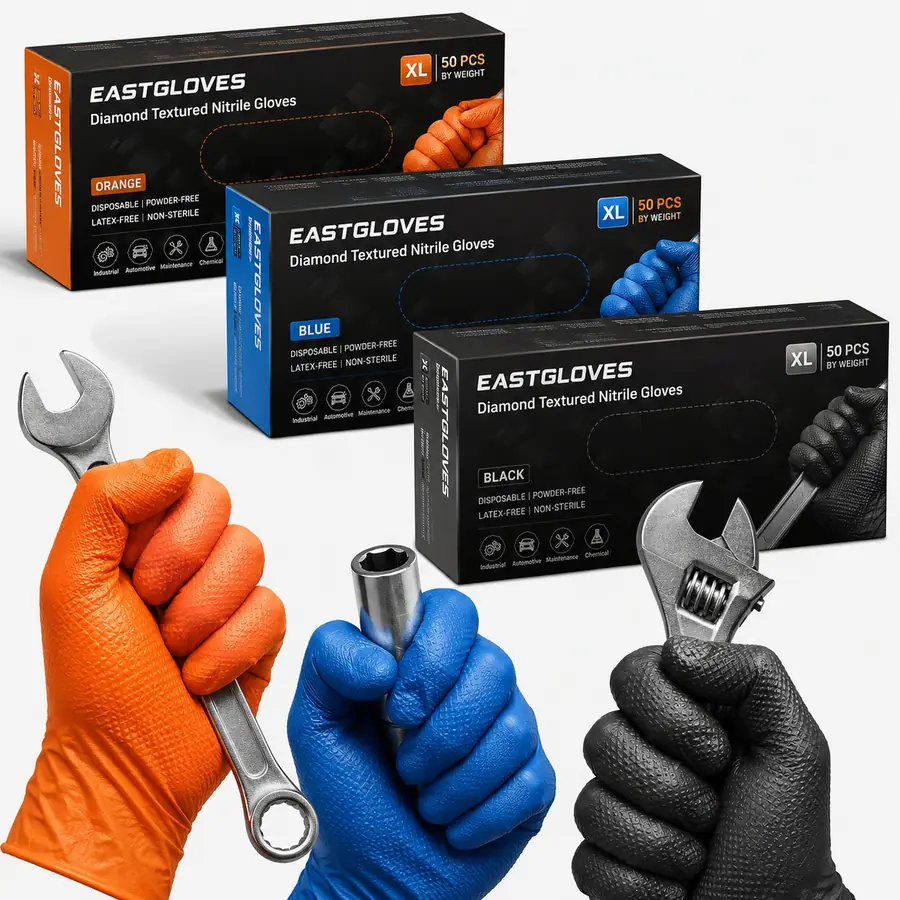
For automotive workshops, dealer service departments and the distributors who supply them, the default disposable glove is black nitrile — and the heavy end of the range, 8 mil diamond-textured nitrile, is what mechanics reach for when the job involves oil, grease and metal edges. This guide is written for buyers: workshop groups standardising one glove across bays, parts and accessory distributors adding a glove line, and importers comparing mechanic nitrile gloves for the automotive aftermarket. EASTGLOVES supplies the range from Ningbo — diamond-texture nitrile gloves and the 8 mil diamond gloves line alongside standard black nitrile — at a 1,000-carton minimum order, FOB Ningbo, with a typical lead time of about 30 days. Everything below specifies disposable mechanic gloves the way trade buyers order them: by grade, by gram weight per size, and by the checks that keep a bulk order consistent.
1. What workshop work actually asks of a glove
A service bay is a hard environment for a disposable glove. Hands meet engine oil, grease, transmission and brake fluids, parts-washer solvent and sharp metal edges, often in the same job. Technicians need grip on oily components, enough film strength to finish a task without a mid-job tear, and a glove they can change quickly between jobs without fighting the cuff. They also wear gloves in front of customers: in a dealer service department, the glove is part of how clean and professional the workshop looks.
Those requirements explain the pattern buyers settle into. The glove has to survive contact with oils without going soft, grip when wet with fluid, and read as a workshop product rather than a kitchen product — which is why the category standardised on black nitrile, in heavier grades than food service uses, with texture doing real work.
2. Why nitrile is the default material in the bay
Nitrile against oils and fluids. Nitrile holds up against the oils, greases and many workshop fluids that degrade natural rubber. Latex gloves soften and break down on contact with petroleum products, which is why latex is the wrong default for engine and transmission work even where nobody has a latex sensitivity. Vinyl sits at the other end: it is a food-service and light-duty material with a looser fit and limited resistance to workshop chemicals, and it tears more readily on metal edges.
Black is functional, not cosmetic. A black glove hides grease and oil staining, so a technician's hands look clean through a job and a service advisor can walk a customer through the workshop without the gloves looking filthy. For distributors, black is also the colour the trade asks for by name — mechanic nitrile gloves means black nitrile to most workshop buyers. The standard black nitrile gloves line covers the lighter grades; the diamond lines below cover the heavy end.
3. Thickness and texture by task
| Workshop task | Working choice | Why |
|---|---|---|
| General bay work, inspections, valeting and detailing support | Standard black nitrile, around 5 mil class | Balance of feel, strength and change frequency for mixed light work |
| Engine, transmission and underbody work | 8 mil diamond-textured nitrile | Heavier film for edges and fasteners; raised diamond grip holds oily parts |
| Parts washing and fluid handling | 8 mil diamond-textured nitrile, changed between jobs | Film strength and grip under constant fluid contact |
| Tyre, battery and roadside-assist kits | Standard black nitrile | Compact, general-purpose glove for kits and mobile work |
The diamond texture deserves a plain explanation: the raised diamond pattern channels fluid away from the contact surface, so the glove grips oily metal instead of skating on it, and the pattern also stiffens the film against tearing. It is the feature mechanics name when they reorder. A documented example of the specification in trade use is our automotive case study on orange diamond nitrile gloves, which shows the colour-and-texture variant a workshop buyer chose. Buyers comparing the heavy end with general industrial supply can cross-check the industrial gloves guide for the overlapping range.
4. Planning sizes and consumption for groups and distributors
Workshop size mix skews larger than food service. Most technician demand sits in L and XL, with M for smaller hands and apprentices; an even split across S–XL usually strands S sizes in the storeroom. Dealer groups standardising across sites should set one mix from actual issue records at two or three representative sites rather than guessing group-wide.
Consumption follows bay count and job mix more than headcount: a technician on engine work changes gloves several times a day, while inspection and detailing work changes less often. Distributors building a first order for the trade should plan the mix by account type — workshop-heavy accounts on the 8 mil line, mixed accounts split between standard black and diamond — and keep the packing simple: 100 pieces per box, 10 boxes per carton, about 31 × 22 × 22 cm and about 5 kg gross per carton on the standard lines, confirmed per SKU on the final packing list.
For distributors, the practical stocking pattern is two grades deep rather than five grades wide: standard black nitrile for breadth across general accounts, and 8 mil diamond for the workshop accounts that ask for it by name. Both lines move in the same carton format, so mixed pallets and split shipments stay straightforward, and one shared size mix — weighted toward L and XL — can serve both grades instead of stranding slow sizes in two separate ranges.
5. Checks to run before a bulk automotive order
- Get the grade in writing. Mil at the palm and gram weight per size on the specification sheet, not just "heavy duty" on a quotation. Standard nitrile reference weights on our lines are about 3.0 g (M), 3.5 g (L) and 4.0 g (XL) for the lighter 100-piece range; the 8 mil diamond line runs about 8.0 g (M), 8.5 g (L) and 9.0 g (XL) per glove, the same weights specified on our diamond-texture nitrile gloves page.
- Wear-test with technicians, not the office. Samples are paid, and sample freight is paid — sample costs can be deducted or refunded after a bulk order is placed. Put the samples on the techs who do the oiliest work, for full jobs, and ask about tears and grip specifically.
- Set the inspection level on the order. EASTGLOVES works to AQL 1.5 to 4.0 depending on use and customer requirement; write the level you agreed into the order so arrival inspection has a standard to run against.
- Confirm documents for your market. Our gloves are supplied under CE certification and ISO 13485 quality management, with Saudi MDMA approval for that market. Ask for the document set that matches the exact SKU and your destination before production starts.
6. Ordering automotive gloves in bulk
Bulk orders start at 1,000 cartons, quoted FOB Ningbo after specification and quantity are confirmed, with a typical lead time of about 30 days from order confirmation. The factory runs about 900,000 pairs per day across its glove lines, so workshop programmes and distributor replenishment orders sit comfortably inside normal production planning — what matters is locking the specification early: grade and texture, sizes and mix, colour, and any private-label box artwork for distributors selling under their own brand. Quotations are prepared per inquiry after those details are confirmed; this guide deliberately carries no price, because the right figure depends on the grade and mix your bays actually use.
Procurement FAQ
Why do mechanics use nitrile gloves instead of latex?
Because workshop oils, greases and many fluids degrade natural rubber latex, softening and weakening the film mid-job. Nitrile resists those fluids, fits closely and is latex-free by material, which is why it became the default glove material in service bays.
What thickness of nitrile glove is right for workshop use?
General bay work usually runs on a standard black nitrile in the 5 mil class. Engine, transmission, underbody and parts-washing work is better served by 8 mil diamond-textured nitrile, where the heavier film and raised grip hold up against edges and oil.
Why are mechanic gloves usually black?
Black hides grease and oil staining, so technicians' hands look clean through a job and in front of customers. It is also the colour the trade orders by name, which makes black the safe stocking choice for distributors.
Is the diamond texture worth it over a smooth glove?
For oily work, yes. The raised diamond pattern channels fluid off the contact surface and stiffens the film, so grip and tear resistance both improve. For light, dry tasks a standard smooth black nitrile is usually enough.
What is the minimum order for automotive nitrile gloves?
The minimum order is 1,000 cartons, packed 100 pieces per box and 10 boxes per carton. Samples are paid, and sample freight is paid; sample costs can be deducted or refunded after a bulk order is placed. Typical lead time is about 30 days from order confirmation.
Should a workshop use disposable mechanic gloves or reusable gloves?
For oil, grease and fluid work, disposable mechanic gloves are the practical default: a contaminated pair comes off in seconds, so fluids and grit are not carried from one job to the next, and every task starts with an intact film. Reusable gloves suit dry, heavy handling away from fluids. Most workshops we supply run disposables across the bays: standard black nitrile for general work, and 8 mil diamond-textured nitrile for engine, transmission and parts-washing jobs.
What to send with your first inquiry
Send the glove type (standard black nitrile or 8 mil diamond), sizes and size mix — workshop buyers usually weight it toward L and XL — quantity in cartons, destination port, and whether the order is for your own workshops or for resale under your brand. If you are replacing a glove your technicians already use, name the grade and what they complain about; "current glove tears on underbody work" points straight at the 8 mil diamond specification. With those details, EASTGLOVES can confirm availability, documents and the FOB Ningbo quotation basis in one round.