700 Cartons of Black Nitrile Gloves Loaded for Jordan — 10 November 2026 Shipment Record
On 10 November 2026, EASTGLOVES loaded 700 cartons of black powder-free nitrile disposable gloves for shipment to Jordan. The order was packed under the buyer's private label, in sizes M and L, at 100 gloves per box and 10 boxes per carton — 7,000 boxes and 700,000 gloves in total. This record sets out what was in the load, how it was checked and secured before dispatch, and what a buyer should confirm before booking a similar order.
Black nitrile gloves are the working glove of garages, tattoo studios and cleaning crews: dark enough to hide ink and grease through a shift, strong enough for mechanical work, and changed as often as the task demands. When a buyer in Jordan orders them by the hundred cartons, the buying questions change. It is no longer about one box — it is about how many cartons make up the order, how the count is checked, how the load is secured inside the container, and what documents travel with it. This shipment is a useful example because it is ordinary: one product, two sizes, private-label cartons, counted, stacked and secured in a single loading. Nothing about it is exceptional, and that is the point. A buyer who understands this load can plan the next one without surprises.
What was in the load
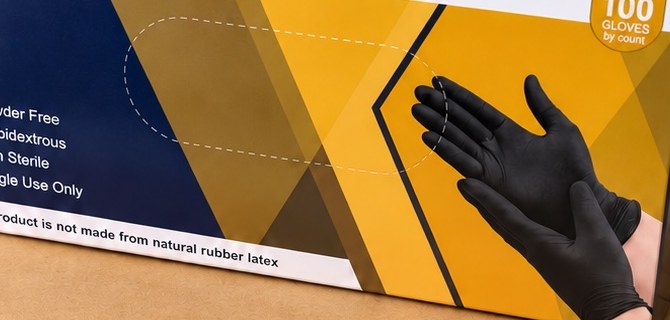
The load was black powder-free nitrile disposable gloves: non-sterile, ambidextrous, and for single use only. The gloves were packed under the buyer's private label, with the cartons carrying the buyer's own box design rather than the EASTGLOVES house pack. Two sizes were loaded, M and L, and each size was packed and marked separately so the count could be checked size by size against the packing list. The box face states the product as powder-free, ambidextrous, non-sterile and single use only, and notes that the product is not made from natural rubber latex — the details a buyer checks first when a carton is opened at destination.
Nitrile gloves are graded by weight at a stated size, and the weight grade belongs on the order next to the size, not on its own. The standard EASTGLOVES nitrile weight scale is S 2.5 g, M 3.0 g, L 3.5 g and XL 4.0 g per glove. A buyer comparing quotations should always compare the same weight at the same size: a lighter glove at the same size is a different product, and a weight quoted without its reference size is not a specification. Our nitrile gloves page and the black nitrile gloves wholesale page set out the product range this load was drawn from.
| Count | Figure |
|---|---|
| Cartons loaded | 700 |
| Boxes per carton | 10 |
| Gloves per box | 100 |
| Total boxes | 7,000 |
| Total gloves | 700,000 |
| Gross weight per carton | About 6 kg |
| Total gross weight | About 4,200 kg |
Standard EASTGLOVES packing is 100 gloves per box and 10 boxes per carton, so one carton holds 1,000 gloves. The arithmetic for this load is straightforward: 700 cartons at 10 boxes each gives 7,000 boxes, and 7,000 boxes at 100 gloves each gives 700,000 gloves. At about 6 kg gross per carton, the load weighs about 4,200 kg in total. That is why glove orders are planned by carton count and volume rather than by weight: a container full of light glove cartons reaches its volume limit long before it reaches its weight limit, and the exact count for any order is confirmed from the final packing list — carton count, carton size and total volume, agreed before loading day.
The carton lot marking on this load shows a production date of 15 October 2026, lot 1013. The lot mark is the link between the cartons in the container and the production batch they came from. If a question ever arises about a carton at destination — a size query, a weight check, a document request — the lot mark is what ties that carton back to its production records. Buyers should ask for the lot marking to be recorded on the packing list, and should keep the packing list with the lot numbers when the goods arrive, so any follow-up can start from the lot rather than from a description of the carton.
How the load was checked and secured
A load is not finished when the last carton goes in. It is finished when the count has been checked, the cartons have been inspected, the load has been secured, and the container doors have been closed. The sequence on this load followed the same pattern used on every EASTGLOVES container order: count, stack, check, close.
First, the count. The loading team counts cartons against the packing list as they go in, size by size, so that a short count in one size is caught during loading rather than discovered at destination. The M and L cartons on this load were kept in separate blocks with their size markings visible, so each size could be found and counted without pulling the whole load apart. Second, carton condition. Cartons are checked as they are handled — crushed corners, torn tape and damp board are all reasons to set a carton aside rather than load it. A carton that goes into a container damaged will not improve on the voyage, and a damaged carton at the bottom of a stack puts the cartons above it at risk. Third, the lot marking. The production date and lot number on the cartons are read and recorded, so the packing list and the load agree on which batch is inside the container.
Once the cartons were stacked, the load was secured with a load bar. The photograph taken inside the container shows a worker setting the bar in place between the container walls, in front of the stacked cartons. A load bar braces the carton wall so it cannot shift forward when the container brakes, turns or is lifted during the voyage. Glove cartons are light and a full stack has a lot of surface area, so a load that is merely stacked — however neatly — can still move. The bar is a simple piece of equipment and it is fitted before the doors close, not after a problem appears. Our container loading guide works through the same planning for different container sizes, including the difference between floor-loaded and palletised loads, and our earlier records show the same count, stack, check and close sequence at other scales: 5,000 cartons of nitrile gloves for Türkiye and a full 40HQ of clear disposable gloves for Saudi Arabia.
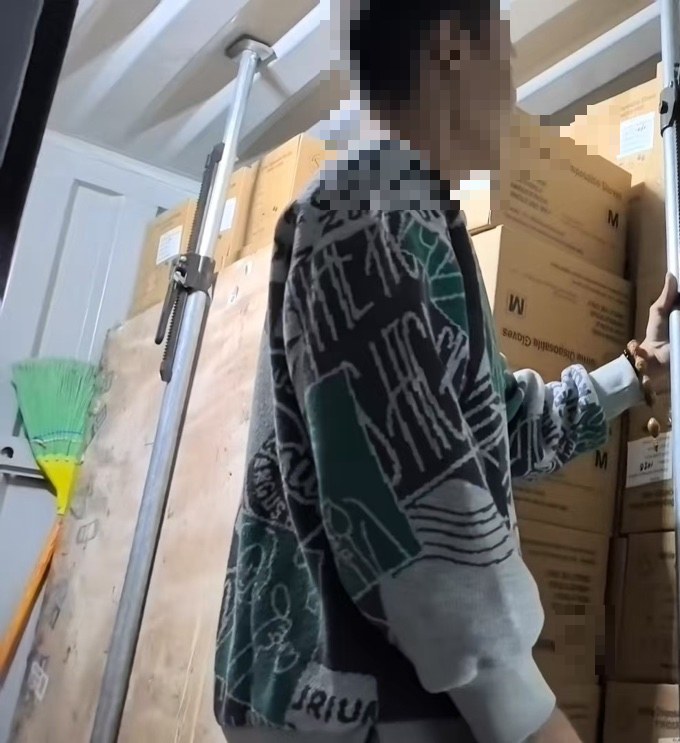
Securing the load is the last step before the doors close, and it is the step most easily skipped when a loading is running late. It should not be. A shifted load can crush cartons, split tape and scatter boxes, and the damage is found at destination, weeks after the container left. The photographs of the loading, the carton wall and the secured load are part of the shipment record — a buyer ordering a similar load should ask for them, and should expect them without having to chase.
What buyers should confirm before booking a similar order
Most of the avoidable problems in glove importing are decided before production starts, not at the port. Use this checklist when you place the order, and keep the answers in writing:
- Material, colour, weight and size mix. Write down the material, the colour, the weight grade with its reference size, and the size split for every SKU. This load was black nitrile, M and L — a size split agreed before production, so cartons could be marked, counted and loaded in blocks that match the packing list.
- Private-label artwork. If the cartons carry your own private label, approve the box artwork early. Artwork approval takes time and it sits in front of production, so allow for it inside the lead time rather than treating it as an afterthought. Confirm who supplies the print files, what the box must state — powder-free, ambidextrous, non-sterile, single use only, and the glove count per box — and get a proof approved in writing before printing.
- Documents matched to the product. Ask for CE certification and ISO 13485 quality-system documentation for the exact material, weight and size range on the order, and check the documents against the quotation before payment, not after the goods have shipped. Ask for the documents matched to your own market's requirements as well.
- Inspection level. Agree the sampling and inspection level for the order in writing. EASTGLOVES supplies to AQL 1.5–4.0 depending on the intended use — agree the level for your order before production.
- Samples first. Samples and sample freight are charged, and the sample cost can be deducted from your first bulk order. Use the sample to check material, weight, size marking and packing against your specification sheet before committing to a full order.
- Lead time and terms. Typical lead time is about 30 days from order confirmation, subject to specification, colour and size mix and packing requirements, plus sea transit time to your destination port. Orders are quoted FOB Ningbo. Confirm the destination port and the consignee details in writing before the container is booked — a container sealed for the wrong port is an expensive mistake to fix, and it is fixed with paperwork, not with gloves.
- Loading record. Confirm who counts the load and ask for photographs of the loading, the carton wall, the load bar and the closed doors. The record is your evidence if anything is questioned at destination.
Shipment FAQ
How many gloves are in 700 cartons?
700,000 gloves. Packing is 100 gloves per box and 10 boxes per carton, so one carton holds 1,000 gloves. 700 cartons at 10 boxes each gives 7,000 boxes, and 7,000 boxes at 100 gloves each gives 700,000 gloves in total.
Which sizes were in this load?
Sizes M and L. The two sizes were packed and marked separately so the count could be checked size by size against the packing list. The standard nitrile size range runs S to XL, so a buyer ordering a different mix confirms the size split in writing before production.
What does the lot marking on the cartons show?
The lot marking shows a production date of 15 October 2026, lot 1013. It ties the cartons in the container back to the production batch they came from, so any question about a carton at destination can be traced to its batch records. Ask for the lot marking to be recorded on the packing list.
What is a load bar, and why is it used?
A load bar braces the stacked cartons so they cannot shift forward when the container brakes, turns or is lifted during the voyage. Glove cartons are light and a full stack has a lot of surface area, so a load that is only stacked can still move. The bar is fitted inside the container, in front of the carton wall, before the doors are closed.
Which documents support an order like this?
CE certification and ISO 13485 quality-system documentation for the exact material, weight and size range on the order. Ask for the documents matched to the product you are buying and to your own market's requirements, and check them against the quotation before payment.
How long does a similar order take?
Typical lead time is about 30 days from order confirmation, subject to specification, colour and size mix and packing requirements, plus sea transit time to the destination port. Private-label artwork approval sits in front of production, so approve the box design early to keep the lead time on track.
Planning a similar order?
A similar order starts with four facts: the material, the weight grade and reference size, the size mix, and the destination port. Send those with your quantity and packing requirements, and the quotation, the packing list and the loading plan all follow from them. If you are still choosing between materials, start with the nitrile gloves product page, or read the container loading guide to work out how many cartons your order needs.
Need a practical disposable gloves quote?
Send Amy your product type, size, colour, quantity, destination country and private-label packaging requirements. Contact Amy on WhatsApp for a prompt response, or use the contact form.